

930 Turbo prices by year: the 1989 G50 costs $60,000 more. Is it worth it?
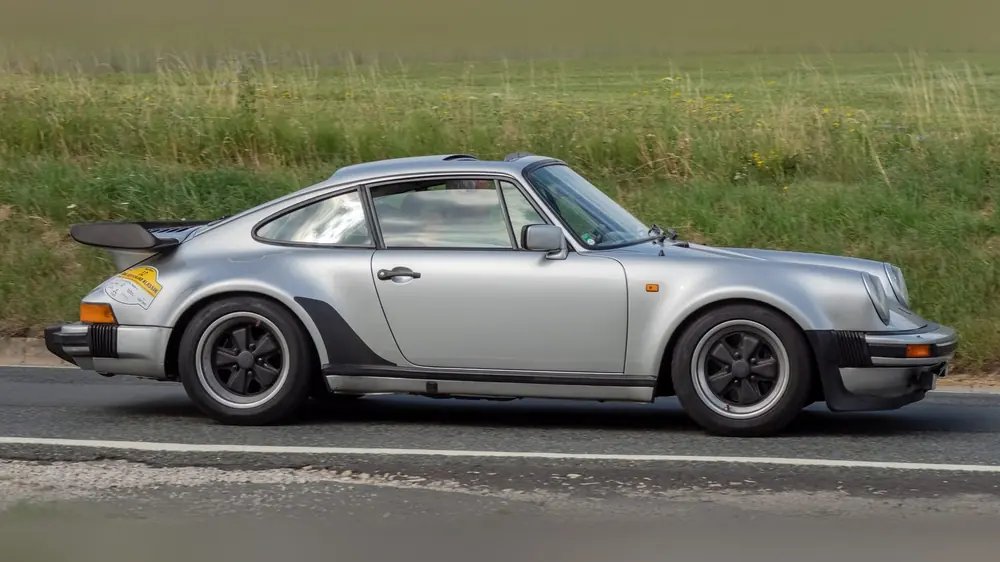
Porsche 930 Turbo price history isn't one story. The 930 isn't one market: year group, where the car was first sold, and whether it's a factory Slant Nose all move the price more than paint or interior condition do.
Here's how the year groups compare on US sales, what the 1989 G50 premium buys you, and where the value sits.
Figures are US sales in US dollars from our Porsche 930 Turbo Buyer's Report, priced as of October 16, 2026. Sources are named at the end.
Which 930 Turbo years were sold new in the US?
Every 930 is a manual: a 4-speed through 1988, then the 5-speed G50 with a hydraulic clutch for 1989. The 1976–77 US cars are 3.0-liter (sold as the 911 Turbo Carrera). From MY1978 the engine grew to 3.3 liters with an intercooler and larger brakes.
Porsche didn't sell the 930 new in the US for 1980 through 1985. New federal emissions rules needed a catalytic converter, and Porsche judged the power loss too high. It came back for MY1986 with an emissions-controlled engine. So a 1975 or 1980–85 car in the US is a "Rest of World" grey-market import.
930 Turbo prices by year group
From our 930 Turbo report, US sales in US dollars, priced as of October 16, 2026:
| Version | Opening offer | Target | Walk-away | Sales (24 mo) |
|---|---|---|---|---|
| 1976–1979 | $125,800 | $166,000 | $190,900 | 21 |
| 1975 and 1980–85 (RoW) | $129,600 | $172,800 | $198,700 | 9 |
| 1986–1988 | $146,500 | $161,000 | $185,200 | 46 |
| 1989 (G50 5-speed) | $175,200 | $221,000 | $254,100 | 8 |
| Slant Nose / Flat-Nose | $195,900 | $253,100 | $291,100 | 8 |
The 1989 G50 target is $60,000 above the 1986–88 target, about 37% more. That's the premium in the headline.
Is the 1986–1988 930 the value buy?
The 1986–88 group has 46 US sales in 24 months, more than every other group combined. In 2026 so far, 24 sold at a $164,000 median, in line with the $161,000 target.
But mileage decides this group, and the report splits it into bands:
| Mileage | Opening offer | Target | Walk-away | Sales |
|---|---|---|---|---|
| Under 25,000 mi | $256,400 | $308,500 | $310,800 | 11 |
| 50,000–99,999 mi | $151,400 | $159,200 | $163,600 | 18 |
| 100,000 mi and up | $111,900 | $146,000 | $156,600 | 8 |
Between July 22 and October 7, four cars at 113,000 to 257,000 miles sold for $88,430 to $156,559. Three at 13,000 to 18,000 miles sold for $307,000 to $311,000. A low-mile car is a separate market, so price it from the mileage table, not the group target.
For a driver-grade 930, a 1986–88 car in the 50,000 to 99,999 mile band, at a $159,200 target, is where the most evidence is.
Is the 1989 G50 worth the premium?
The 1989 car gets the G50 five-speed and hydraulic clutch, the only 930 with a fifth gear. That is a real difference to drive. Buyers pay for it, and for the fact that it was the last year.
The data is thin: 8 US sales in 24 months, 6 in the last 12. In 2026, five G50 cars sold. Three brought $233,000 to $277,000 and two brought $172,000 and $176,000.
Miles explain the split. The three at 32,000 to 55,000 miles were the $233,000 to $277,000 cars. The two over 100,000 miles were the $172,000 and $176,000 cars. The report's guidance: for a 30,000 to 55,000 mile car with records, expect to pay at or above the $221,000 target. For a car over 100,000 miles, offer near $175,000.
So is it worth it? If you want the five-speed and you're buying a documented, mid-mileage car, the premium is the market price and you'll pay it. If you mainly want a 930 to drive, a 1986–88 car gives you the same era and body for $60,000 less at target, with far more cars to choose from.
Whatever you pay, confirm the G50 and hydraulic clutch are original to the car. Don't pay a 1989 price for a four-speed car.
What do 1976–1979 930s sell for?
The early cars had 21 US sales in 24 months. In 2026, 11 sold for $96,500 to $246,400 at a $166,000 median. A 175-mile car brought exactly the $166,000 target in September, so mileage alone doesn't explain the spread. In the 50,000 to 99,999 mile band, seven sales ranged from $96,500 to $225,000. Condition and history move the price more than miles here.
Buying a RoW car or Slant Nose: paperwork first
RoW cars (1975, 1980–85): 9 US sales in 24 months, target $172,800. The three in 2026 brought $150,000, $195,500 and $206,000. Get the EPA and DOT import release paperwork and check the title history before you agree a price.
Slant Nose: 8 US sales in 24 months, target $253,100. Three sold in 2026, for $156,000, $276,000 and $494,500 (the top car had 2,492 miles). Porsche publishes no official count; its own article says "it's believed that 948" were built, so treat that as an estimate.
The harder problem: Porsche Vehicle Documentation says Special Wishes options don't appear on its Production Specification or Classic Technical Certificate, and it won't release the original factory record card. So Porsche's documents may not prove a factory Slant Nose. Sports Car Market says to verify option codes, production records and body details, not just the nose. Have a 930 specialist inspect the car.
What to inspect on a 930 Turbo
From the Porsche Club of America's model guide and Classic Motorsports:
- Leak-down and compression test, with results in writing. Every car needs one.
- Head studs: broken studs are a known 930 issue. Ask what studs are fitted. An ARP head-stud kit alone is $935.76 at Evasive Motorsports. With no stud record, price in a stud job.
- Magnesium alternator and fan housing: check for cracks and corrosion.
- CIS fuel injection: check cold and hot starts. On 1986–89 cars, faults can damage the catalytic converter.
- Body: rear frame rails for collision damage; window frames and the front suspension pan under the battery for corrosion.
- Clutch and transaxle: on a four-speed car, a clutch job means the engine and transaxle come out.
- Engine rebuild: "rebuilt" with no invoices is a red flag.
Repasi Motorwerks lists a KKK K27 turbo rebuild at $1,500 to $3,000. Its general price list puts a major service at $1,200 to $2,500.
Modified cars are a separate market. The report lists eight recent modified or non-US-market sales and leaves them out of every target.
Frequently asked questions
Which 930 Turbo year is the best value?
On US sales, 1986–88 cars have the most sales (46 in 24 months) and a $161,000 target, $60,000 below the 1989 G50.
Why does the 1989 930 cost more?
It's the only 930 with the five-speed G50 gearbox and hydraulic clutch. Its target is $221,000, on 8 US sales in 24 months.
Were 930 Turbos sold new in the US from 1980 to 1985?
No. Porsche withdrew the Turbo from the US for those years, so 1980–85 cars here are Rest of World imports.
The bottom line
The 1986–88 car is the value buy, with the most sales and the clearest prices. Pay the G50 premium only for a documented car, and price it by its miles. For RoW and Slant Nose cars, settle the paperwork before you talk about condition. For a later 911 Turbo, see our 996 Turbo price trend guide.
The full report has every year group's mileage and model-year detail, the excluded sales, warranty and Porsche Classic options, and the seller questions. Get the full Porsche 930 Turbo Buyer's Report.
Sources: Porsche Club of America, Porsche Cars North America, Porsche Vehicle Documentation, Classic Motorsports, Sports Car Market, Evasive Motorsports, Repasi Motorwerks, NHTSA, NMVTIS.